
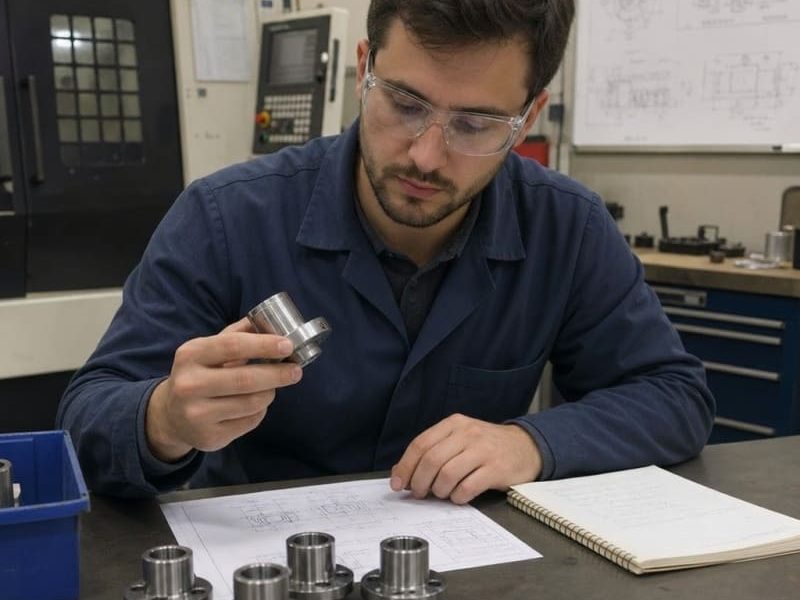
Low volume manufacturing helps businesses make a limited number of parts or finished products without committing to large production runs. It is especially useful when a product is new, demand is uncertain, design changes are likely, or customers need specialized configurations. This guide explains how low volume production works, where it fits, and how to choose the right low volume manufacturing service for prototypes, metal components, sheet metal parts, and custom manufacturing solutions.
What is low volume manufacturing?
Low volume manufacturing is the production of small quantities of parts or products, usually with more flexibility than traditional mass production. Instead of building expensive tooling and producing thousands or millions of identical units, companies use adaptable processes to manufacture smaller batches efficiently. The exact quantity depends on the industry, part complexity, material, and production method, but the main idea is controlled output with room for change.
This approach sits between one-off prototype manufacturing and full-scale mass production. It allows teams to test designs, serve niche markets, validate demand, and respond quickly to customer requirements. For many companies, low volume production is not just a temporary step before scaling. It can be the best long-term model for specialized products, replacement parts, medical devices, aerospace components, electronics enclosures, industrial equipment, and engineered metal parts.
Common low volume manufacturing methods include CNC machining, sheet metal fabrication, urethane casting, additive manufacturing, injection molding with bridge tooling, and pcb assembly services. Low volume manufacturing metal projects may involve aluminum, stainless steel, carbon steel, brass, or other application-specific materials. For enclosures, brackets, panels, and chassis, low volume production sheet metal is often a practical choice because it can support precise forms without requiring the same upfront commitment as high-volume tooling.
The core benefits of low volume production
Low volume production gives product teams more control over cost, risk, timing, and design evolution. Instead of locking into a final design too early, businesses can manufacture usable parts, gather feedback, and improve the product before making larger investments. This makes the model valuable for both startups and established manufacturers.
Key benefits include:
- Lower upfront risk: Businesses can avoid ordering excessive inventory before market demand is proven.
- Faster product development: Small batches help teams move from concept to functional parts more quickly.
- Design flexibility: Engineers can update materials, dimensions, finishes, or features between production runs.
- Better cash flow: Smaller orders reduce the pressure to tie capital up in unsold inventory.
- Market testing: Companies can launch limited runs, pilot programs, or beta products before scaling.
- Customization: Small batch manufacturing supports varied customer requirements without forcing every order into one standard design.
- Supply chain resilience: Smaller, repeatable batches can make it easier to adjust production schedules when demand changes.
For businesses that serve technical or niche markets, these benefits can be strategic. A company may need 50 precision housings, 200 custom brackets, or a short run of assembled units for a pilot deployment. In those cases, a low volume production service can provide commercial-quality results without requiring a mass-production commitment.
When does low volume manufacturing make the most sense?
Low volume manufacturing makes the most sense when flexibility, speed, or customization matters more than the lowest possible per-unit cost. It is ideal for products that are still evolving, products with specialized demand, or parts that are needed in limited quantities. It also works well when the cost of overproduction would be greater than the savings from a large run.
Several situations point toward a low volume manufacturing service rather than full-scale production:
- New product introduction Teams can produce early batches for testing, demonstrations, trade shows, investor samples, or customer pilots.
- Bridge production A business can supply customers while waiting for high-volume tooling, supplier approval, or final production readiness.
- Custom or configurable products High mix low volume manufacturing is useful when every order may require a different size, hole pattern, finish, material, or assembly detail.
- Replacement or legacy parts Manufacturers can produce parts that are no longer available from original suppliers without maintaining large inventories.
- Demand uncertainty Small batches help companies avoid guessing too aggressively before sales patterns are clear.
- Specialized industrial applications Equipment builders, laboratories, defense suppliers, automation integrators, and medical technology teams often need precise parts in limited quantities.
Low volume production is not always the cheapest option per unit. However, the total business case can be stronger when it reduces waste, shortens development cycles, and prevents costly mistakes before a product reaches a larger market.
Low volume manufacturing compared with mass production
Mass production is designed around repetition. Once tooling, fixtures, processes, and supply chains are established, the goal is to produce a high number of identical units at a low unit cost. Low volume manufacturing, by contrast, prioritizes adaptability and practical speed.
| Factor | Low volume manufacturing | Mass production |
|---|---|---|
| Typical goal | Flexibility, validation, customization | Scale, consistency, low unit cost |
| Upfront investment | Often lower | Often higher |
| Design changes | Easier to incorporate | More expensive after tooling is complete |
| Inventory exposure | Lower | Higher |
| Best fit | Prototypes, pilot runs, niche products, custom parts | Mature products with stable demand |
| Unit cost | Usually higher | Usually lower at scale |
The right choice depends on product maturity and demand confidence. If a design is still changing, mass production may create unnecessary risk. If demand is stable and the design is locked, high-volume production may become more efficient.
A smart manufacturing strategy may use both. Prototype manufacturing can validate the concept, low volume production can support early customers, and larger-scale production can follow once the product and market are ready.
High mix low volume manufacturing and customization
High mix low volume manufacturing describes an environment where many different product variations are produced in small quantities. This is common in industries where customers need tailored parts, specialized assemblies, or application-specific configurations. The “high mix” part refers to variety, while the “low volume” part refers to smaller quantities per design.
This model requires strong process control. A manufacturer must manage changing drawings, materials, work instructions, inspection requirements, and delivery schedules without losing accuracy. It also requires clear communication between the customer and the production team.
For example, a company might need several versions of a sheet metal enclosure: one with extra ventilation, one with a different mounting pattern, and one with a powder-coated finish. Instead of forcing a single standard product, custom manufacturing solutions allow each version to be built for its use case. That flexibility can improve product fit, installation efficiency, and customer satisfaction.
Materials and processes used in small batch manufacturing
Small batch manufacturing can use many of the same materials and processes as larger production, but the setup is often optimized for shorter runs. The best process depends on geometry, tolerance, surface finish, strength, cost target, and delivery schedule.
CNC machining
CNC machining is widely used for low volume manufacturing metal parts because it can produce accurate components without dedicated molds. It is suitable for blocks, housings, brackets, fixtures, prototypes, and functional end-use parts. It also supports a wide range of metals and plastics, making it a strong option for engineering validation.
Sheet metal fabrication
Low volume production sheet metal is useful for panels, covers, cabinets, chassis, mounting plates, and enclosures. Processes may include laser cutting, bending, punching, welding, hardware insertion, and finishing. Sheet metal is often attractive because it can balance strength, weight, cost, and manufacturability.
Additive manufacturing
Additive manufacturing can help teams create complex geometries, visual models, jigs, fixtures, and functional prototypes. It may not be the right choice for every production part, but it can reduce iteration time and support early design learning.
Casting, molding, and bridge tooling
When a product needs molded-like performance but is not ready for full production tooling, bridge tooling or short-run molding can help. These methods may support early market entry while giving the team time to refine the design.
How to choose low volume manufacturing companies?
The best low volume manufacturing companies combine technical capability, communication, quality control, and realistic guidance. They should be able to review your drawings, identify manufacturability issues, recommend suitable processes, and explain trade-offs clearly. A strong partner does more than take an order; it helps you avoid design, material, and production problems before they become expensive.
Use this checklist when evaluating a low volume contract manufacturing partner:
- Process fit: Do they offer the right manufacturing methods for your part, such as CNC machining, sheet metal fabrication, finishing, or assembly?
- Material experience: Can they work with the metals, plastics, or specialty materials your product requires?
- Design support: Will they provide design for manufacturability feedback before production begins?
- Quality expectations: Can they inspect critical dimensions and document requirements when needed?
- Scalability: Can they support future production increases if demand grows?
- Communication: Do they respond clearly, ask useful questions, and confirm assumptions before quoting?
- Lead time transparency: Do they explain what affects timing, such as material availability, finishing, or revision changes?
It is also helpful to share complete information early. Provide drawings, CAD files, material requirements, target quantities, finish expectations, tolerance priorities, and the intended use of the part. The more context a manufacturer has, the better they can recommend an efficient path.
Practical steps for a successful low volume project
A low volume manufacturing project works best when the customer and supplier align before production starts. Rushing into fabrication without clear requirements can cause delays, rework, or mismatched expectations.
Follow these steps:
- Define the purpose of the run Decide whether the batch is for testing, customer delivery, certification support, market validation, or replacement inventory.
- Separate critical from noncritical features Not every dimension needs the tightest tolerance. Identifying critical features can reduce cost and simplify production.
- Choose materials based on function Consider strength, corrosion resistance, weight, appearance, temperature exposure, and regulatory needs.
- Request manufacturability feedback Ask the manufacturer where the design can be simplified without hurting performance.
- Approve a sample or first article when appropriate For important parts, checking an initial unit can reduce risk before the full batch is completed.
- Document revisions carefully Low volume production often involves iteration, so version control is essential.
Final takeaways
Low volume manufacturing gives companies a practical way to produce real parts without the cost and rigidity of mass production. It supports product development, market testing, customization, replacement parts, and specialized industrial needs. Whether the project involves prototype manufacturing, low volume manufacturing metal components, or low volume production sheet metal, the goal is the same: make the right quantity at the right quality level with enough flexibility to improve over time.
For businesses comparing low volume manufacturing companies, the best partner is one that understands both production and product development. Look for clear communication, process expertise, manufacturability support, and the ability to grow with your needs. With the right approach, low volume production can reduce risk, speed up learning, and turn complex product ideas into reliable finished parts.
Recent Comments