
Table of Contents
ToggleRigid PCB manufacturing has moved far beyond basic board production. Today’s buyers need partners who can translate design intent into reliable printed circuit boards, manage component availability, and support testing from prototype through production. A low quote doesn’t help if the board arrives late, doesn’t fit the enclosure, or fails functional test. What matters is whether the manufacturer can review your files, catch manufacturability risks, and deliver boards that work in the final product.
This page outlines the modern techniques, assembly options, and value checks that help engineering and procurement teams request a clearer, more useful quote.
What Should You Expect from a Modern Rigid PCB Manufacturing Partner?
A capable partner should do more than fabricate rigid circuit boards. You should expect design-for-manufacturing feedback, controlled circuit board fabrication, practical assembly guidance, documented quality checks, and support for sourcing decisions that affect lead time and cost. The right conversation starts with your application requirements, not with a generic board price.
For buyers comparing suppliers, the most useful partner is one that can explain trade-offs clearly: material selection, stack-up, surface finish, component placement, panelization, inspection, and test strategy. That level of communication reduces surprises before production begins and helps your team make decisions with technical and commercial context.
Advanced Rigid PCB Techniques Improve Reliability
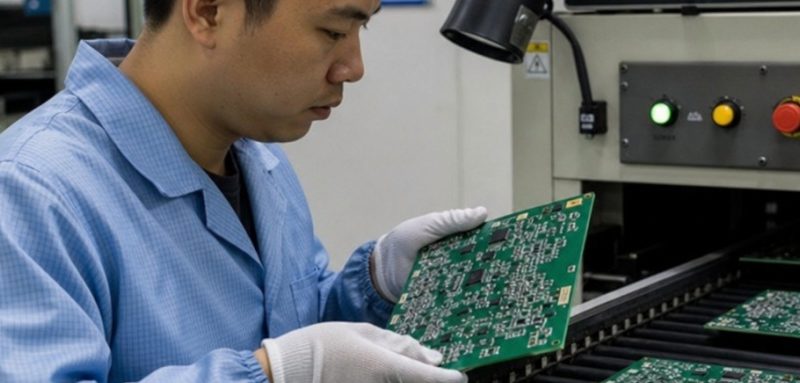
Modern rigid-printed-circuit-board-assembly depends on precision at each stage of the PCB manufacturing process. Better imaging, tighter process controls, cleaner drilling practices, and improved solder mask registration all help support consistent electrical performance. These advancements matter when boards must fit compact housings, carry dense component layouts, or operate in demanding industrial environments.
A well-managed process also improves repeatability. Instead of treating fabrication and assembly as separate handoffs, strong PCB assembly services align engineering review, manufacturing setup, component sourcing, assembly, and inspection. That connected workflow makes it easier to catch design risks early and maintain traceability across builds.
Key manufacturing considerations include:
- Material and stack-up review: Confirms board thickness, copper weight, dielectric needs, and routing constraints before production
- Drilling and plating control: Supports stable vias, through-holes, and interconnect performance
- Solder mask and surface finish selection: Helps protect copper, support solderability, and match assembly requirements
- Panelization planning: Improves handling efficiency and reduces avoidable stress during assembly
- Inspection and testing alignment: Ensures the test plan reflects the board’s real-world function, not only its appearance
Assembly Process Overview for Faster Quoting
A clear assembly process overview helps your team submit better data and receive a more accurate response. Before requesting a quote, gather the files and assumptions that affect manufacturing decisions. This saves time for engineers, buyers, and production planners.
If you need prototypes before production, our PCBA prototype assembly service covers small-batch builds with the same process controls used in volume production.
Use this checklist before inquiry:
- Gerber or ODB++ files with current revision details
- Bill of materials including approved manufacturer part numbers where available
- Pick-and-place data for SMT assembly
- Assembly drawings showing polarity, special handling notes, or mechanical constraints
- Target quantities for prototype, pilot, and production needs
- Testing expectations such as visual inspection, AOI, electrical test, or functional test support
- Application context so the supplier can flag thermal, vibration, enclosure, or compliance concerns
This information allows the manufacturing team to evaluate manufacturability, identify missing data, and recommend the right production path. It also helps prevent quote revisions caused by unclear files or incomplete component details.
Comparing Standard PCB Assembly with Advanced Options
Comparing standard PCB assembly against more advanced build types helps clarify what your product truly needs. A standard rigid board may be the right choice when the design is mechanically stable, the enclosure has enough space, and the interconnect strategy is simple. It’s often suitable for control boards, interface boards, power-related modules, test equipment, and industrial electronics.
Advanced requirements may call for more detailed engineering review. Designs with high component density, thermal sensitivity, strict dimensional limits, or complex interconnect needs benefit from early collaboration. In some cases, the better choice may involve flexible PCB assembly or rigid-flex PCB assembly, especially when movement, folding, or space reduction is part of the design.
| Build type | Best fit | Buyer consideration |
|---|---|---|
| Rigid PCB assembly | Stable, flat installations | Often straightforward to fabricate and assemble when documentation is complete |
| Flexible PCB assembly | Dynamic bends or compact routing paths | Requires careful bend radius, material, and handling review |
| Rigid-Flex PCB assembly | Integrated rigid sections with flexible interconnects | Reduces connectors but requires tighter design and process coordination |
Manufacturing Capabilities and Sourcing Support Reduce Risk
Manufacturing capabilities and technical certifications should be evaluated with care. Instead of assuming a supplier can meet every requirement, ask which board types, layer counts, materials, finishes, tolerances, inspection methods, and documentation practices are available for your specific project. If your industry requires specific certifications or compliance documentation, request confirmation before placing an order.
Component sourcing and turnkey services can also simplify the buying process. A turnkey approach may include PCB fabrication, component procurement, assembly, inspection, and shipment coordination. This is useful when your internal team wants to reduce vendor management, avoid mismatched lead times, or receive one coordinated production update.
When discussing turnkey support, ask about:
- Approved supplier channels for components
- Alternatives for obsolete, constrained, or long-lead parts
- Documentation for substitutions before purchase
- Handling of customer-supplied parts
- Packaging and labeling expectations
- Revision control during repeat orders
These details protect both engineering intent and purchasing efficiency.
Industry Applications and Value Metrics Guide Better Decisions
Industry application engineering and value metrics help connect technical choices to business outcomes. A low board quote may not be the best value if it increases rework, delays assembly, or creates sourcing problems. Better value comes from matching the manufacturing plan to the product’s operating environment, production volume, and lifecycle expectations.
Rigid circuit boards are commonly used in:
- Industrial controls
- Medical devices
- Consumer electronics
- Communications hardware
- Test instruments
- Energy systems
- Embedded computing products
Each application has its own priorities. A control board may need rugged connectors and clear serviceability, while a compact device may prioritize component density and thermal management.
Useful value metrics include first-pass assembly quality, documentation completeness, component availability, inspection coverage, engineering response time, and repeat-order consistency. These are practical measures your team can discuss with a supplier before production starts.
Cost Factors in Rigid and Rigid-Flex PCB Assembly
Cost factors in rigid-flex PCB assembly and rigid PCB builds usually come from design complexity, materials, layer count, board size, tolerances, component availability, testing needs, and order quantity. Cost is rarely only about square inches of laminate. Assembly labor, inspection requirements, fixture needs, and procurement risk can shape the final quote.
To control cost without weakening quality, involve the manufacturer before layout release. Early feedback can identify oversized panels, unnecessary complexity, hard-to-source parts, or placement choices that slow assembly. For rigid-flex designs, design changes made late in the process can be especially expensive because mechanical and electrical requirements are closely linked.
A stronger quote request should include your target production path. If you need prototypes first, say so. If you expect volume production later, share that context so the supplier can advise on scalable choices rather than short-term fixes.
Start Your Rigid PCB Manufacturing Inquiry
If you are evaluating printed circuit boards for a new build, redesign, or production transfer, begin with a manufacturability conversation. Share your files, quantities, application context, and testing expectations so the team can review the real requirements behind the board.
Request a quote or engineering review for circuit board fabrication, PCB assembly services, turnkey sourcing, standard rigid boards, flexible PCB assembly, or rigid-flex PCB assembly. The more complete your starting package, the faster you can move from design review to a practical production plan.
Frequently Asked Questions
Choose rigid when the board stays flat and mechanically supported. Consider flexible or rigid-flex when the design needs bending, folding, connector reduction, or compact routing. Rigid-flex requires more upfront planning but can simplify the overall product architecture.
Yes, but clearly mark what is preliminary. A supplier can often identify missing details before a formal quote. Partial packages can support early estimates, but final quotes usually require complete design and assembly data.
File completeness, material availability, component sourcing, inspection requirements, and order quantity are major factors. Long-lead components and custom materials often extend timelines more than fabrication itself.
Yes. Define inspection and electrical or functional testing expectations early so the quote reflects the real production requirement. Adding testing after the quote is issued often delays production and increases cost.
A rigid PCB uses a solid substrate and stays flat. A rigid-flex PCB combines rigid sections with flexible interconnects in one structure, allowing the board to bend or fold. Rigid-flex reduces connectors and cables but requires tighter design and process coordination.
Ask about ISO9001 as a baseline, and ISO13485 for medical or IATF16949 for automotive if your product requires it. Also confirm UL recognition, RoHS compliance, and any customer-specific documentation requirements before placing an order.
Recent Comments